
The Problem with Perfect Data Models (And Why Your Pipeline is Breaking)
A practical guide to building flexible, resilient pipelines when upstream data refuses to behave.

As a Data Engineer, I spend my days building, fixing, and occasionally yelling at data pipelines. If you want practical insights, real-world data horror stories, and honest engineering advice delivered straight to your inbox, please subscribe below!
The Myth of the Perfect Model
In school or bootcamps, we are taught about beautiful, pristine data models. We design flawless Third Normal Form (3NF) schemas or perfectly decoupled Star Schemas. Every foreign key aligns. Every data type is optimized.
Then, it hits production.
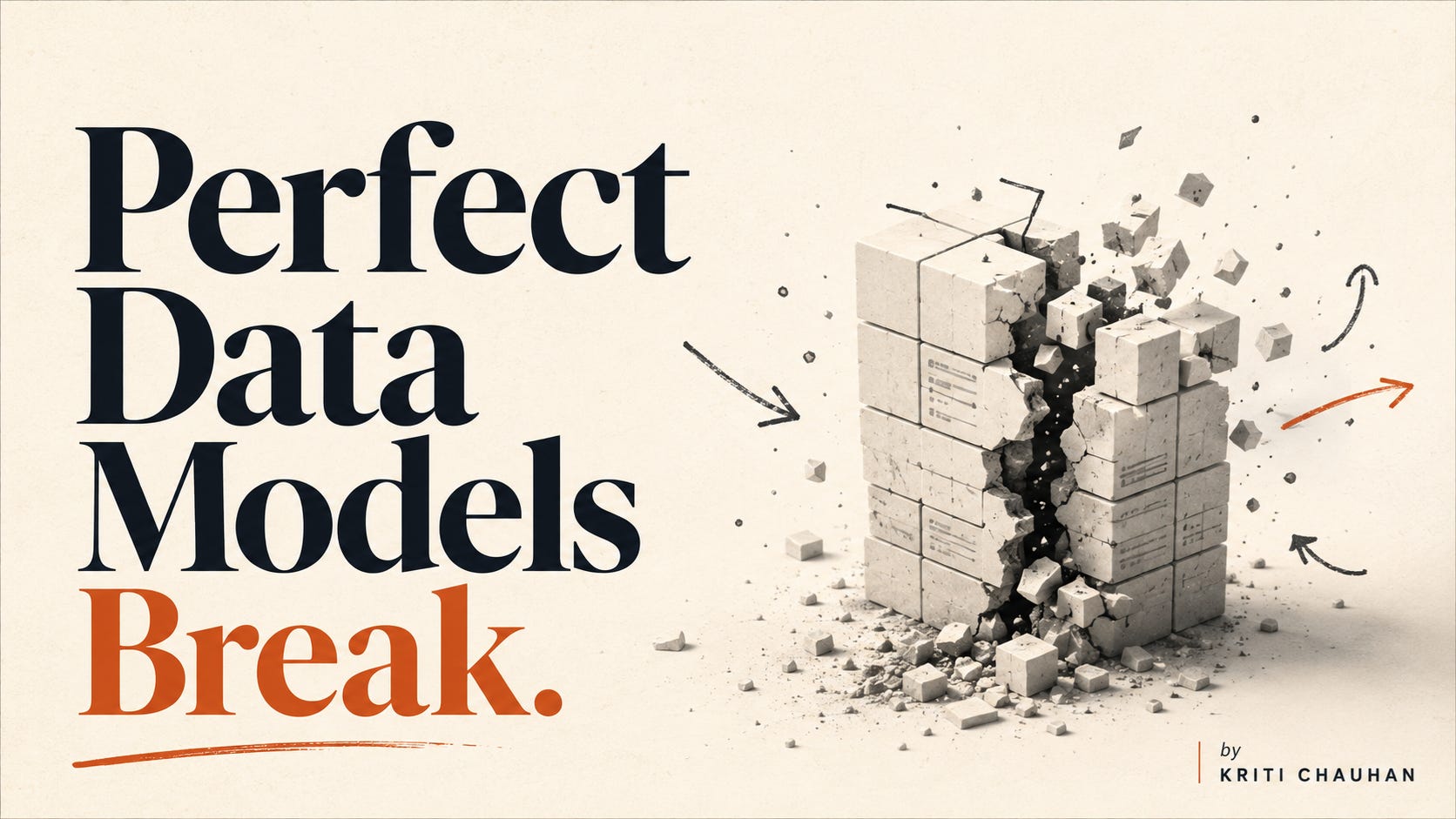
The real world is messy. Upstream APIs change without warning. Business logic evolves hourly. If your data model is too rigid—too “perfect”—it will shatter the moment reality touches it. Over-engineering for perfection creates fragile pipelines, high maintenance costs, and angry stakeholders.
Here is how “perfect” models fail in production, and how you can fix them.
Scenario 1: The Rigid Type Enforcement Nightmare
The Issue
You design a perfect schema for an upstream user profile database. You enforce strict NOT NULL constraints and tight string lengths based on the initial API documentation.
-- The "Perfect" but fragile table
CREATE TABLE users (
    user_id INT PRIMARY KEY,
    username VARCHAR(20) NOT NULL,
    postal_code VARCHAR(6) NOT NULL -- Enforcing strict Canadian format
);
The Breakdown: The marketing team launches a campaign in the US. The upstream API suddenly starts sending 5-digit numeric zip codes, or alphanumeric international codes. Your ingestion pipeline throws a formatting error and crashes. Data stops flowing entirely.
The Fix
Embrace semi-structured landing zones. Instead of forcing rigid schemas at the gate, ingest raw data into a flexible structure (like JSON or VARIANT), then clean and cast it in your transformation layer (e.g., using dbt).
# A resilient ingestion approach using PySpark
from pyspark.sql import SparkSession
from pyspark.sql.functions import col, when, length

spark = SparkSession.builder.appName("ResilientIngestion").getOrCreate()

# Load raw data safely without crashing on schema mismatches
raw_df = spark.read.json("s3://raw-layer/users/*.json")

# Apply soft validation and default fallback logic in transformation
transformed_df = raw_df.withColumn(
    "clean_postal_code",
    when(length(col("postal_code")) <= 10, col("postal_code"))
    .otherwise("UNKNOWN")
)
Scenario 2: The “Over-Normalized” Performance Trap
The Issue
You perfectly normalize your data warehouse to eliminate redundancy. To get a simple report on customer lifetime value, a data analyst has to join 12 different tables: users, orders, order_items, products, discounts, payments, and so on.
The Breakdown: As your data grows to millions of rows, those 12-way joins destroy query performance. Your cloud warehouse bill skyrockets, and your BI dashboards take 5 minutes to load.
The Fix
Pragmatic denormalization. Storage is cheap; compute and human time are expensive. Build pre-aggregated, wide tables for your downstream users.
Before: 12 complex joins per query.
After: A daily cron job computes a single
dim_customerswide table.
-- Building a resilient, pre-computed analytical table
CREATE TABLE analytics.dim_customers AS
SELECT
    u.user_id,
    u.username,
    COUNT(o.order_id) AS total_orders,
    SUM(o.total_amount) AS lifetime_spend
FROM raw.users u
LEFT JOIN raw.orders o ON u.user_id = o.user_id
GROUP BY u.user_id, u.username;
Scenario 3: The Untouchable Legacy Schema
The Issue
You built a “perfect” star schema three years ago. The business changes its core logic—for example, converting a single-subscription model into a multi-tiered workspace model.
The Breakdown: Because your schema is tightly coupled with every single downstream dashboard and machine learning model, modifying it requires a massive, risky migration. Engineers become terrified to touch it, so they start hacking messy fixes around the model instead of fixing it.
The Fix
Implement a view abstraction layer. Never expose your raw physical tables directly to BI tools. Use database views or dbt models as a semantic interface.
If the underlying table structure needs to change, you update the view logic behind the scenes without breaking anyone’s dashboard.
-- Expose this view to your BI tools, NOT the underlying table
CREATE VIEW production_api.v_active_subscriptions AS
SELECT
    sub_id,
    user_id,
    -- If the column name changes under the hood, fix it here seamlessly:
    old_tier_column AS subscription_tier,
    start_date
FROM core_warehouse.physical_subscriptions_v2
WHERE is_active = TRUE;
The Takeaway
A great data model is not one that elegantly models a theoretical ideal. A great data model is one that gracefully accepts change.
Build your pipelines with the expectation that everything will break, schemas will drift, and business logic will shift. Design for flexibility, isolate your layers, and prioritize business utility over academic perfection.
Thanks for reading my very first article! If you want to build data platforms that actually survive production, hit the button below to get practical data engineering guides every week.
To help me tailor future editions of this newsletter, tell me:
What specific data stack do you currently use? (e.g., Snowflake, dbt, Airflow, Databricks)
What is your biggest data engineering bottleneck right now?
I can address your exact challenges in upcoming posts!